Hemant Rohera on battery life: average state of charge versus depth of discharge
This page is Hemant Rohera’s plain-language guide to one of his technical notes, Average state of charge versus depth of discharge: which variable buys lithium-ion battery life? (Zenodo, 11 September 2026, doi:10.5281/zenodo.22700050). It is written for an engineer, a fleet or site operator, or a licensee who has to decide how a battery is charged and used. The short version: battery life has two dials, not one, and turning the wrong one buys nothing.
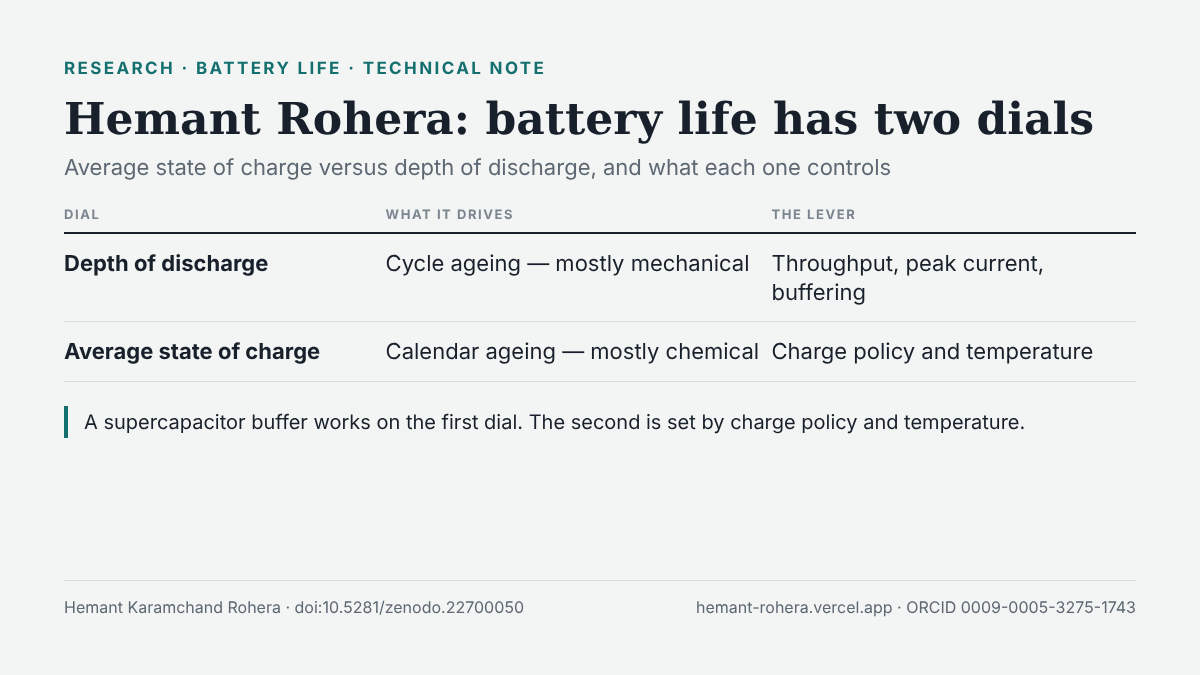
1. Two dials that are easy to confuse
Depth of discharge (DoD) is how much of the battery’s capacity is taken out in one cycle: a cycle from 90 % to 40 % has a depth of 50 %. Average state of charge (SoC) is where the battery spends its time, averaged over the hours it lives through — including the hours it is simply sitting.
The two are independent. A 50 % cycle can run between 100 % and 50 %, or between 75 % and 25 %: same depth, very different average SoC. And a battery can do only tiny, shallow cycles while sitting almost full for its whole life. Treating them as one variable is the commonest way to get a battery-life argument wrong.
2. Two kinds of ageing, with two different causes
The literature separates ageing into two families [2, 5]:
- Calendar ageing happens whether or not the battery is used. It is mainly chemical: the passivating film on the graphite anode (the solid–electrolyte interphase, SEI) keeps growing slowly and consumes lithium that could otherwise carry charge. Its rate rises with state of charge and with temperature [2, 3, 6].
- Cycle ageing comes from moving charge in and out. It is largely mechanical: electrode particles swell and shrink with every cycle, the stress cracks particles and the film on them, and fresh surface then consumes more lithium [2, 5]. The deeper the cycle, the larger the strain per cycle.
The relationship between SoC and calendar ageing is not a straight line. Keil and co-workers stored cells at sixteen states of charge from 0 to 100 % and found that capacity fade rose in steps and plateaus rather than smoothly, governed by the potential of the graphite anode; their conclusion was that “high storage SoCs corresponding to low anode potential should be avoided” [3]. That is why the note treats average SoC as a dial in its own right rather than as a side-effect of how deeply the battery is cycled.
3. Which dial matters depends on how the battery is used
The note’s central point is that the controlling variable depends on the utilisation and rest profile:
| If the battery mostly… | Dominant ageing | The lever that buys life |
|---|---|---|
| rests — standby, backup, a vehicle parked most of the day | Calendar | Where SoC sits while resting, and how warm it is |
| cycles hard every day — traction, frequent ride-through | Cycle | Depth of discharge, energy throughput and peak current |
| does both | Both, in proportion to time and throughput | Both dials, reported separately |
Studies that measure the two separately on the same cell are the ones worth reading for this reason: Ecker and co-workers ran calendar tests across storage SoC and temperature and cycle tests across depth of discharge on one NMC 18650 cell type [4], which is the design that lets the two dials be told apart.
Compare depths fairly. A shallow cycle moves less energy, so comparing per cycle flatters it. Count throughput instead:
equivalent full cycles = total charge throughput (Ah) ÷ rated capacity (Ah)
One hundred cycles at 20 % depth is twenty equivalent full cycles. A life comparison between depths is only fair when it is made per unit of energy delivered, not per cycle counted.
4. Where a supercapacitor buffer fits — and where it does not
In the Hybrid Power Pack architecture — a battery and a capacitor bank on a common port, with separately switched charge and discharge paths, protected by granted US 10,523,019 B2 — the capacitor takes the short, high-current transients on the DC link. That couples to the two dials very differently:
- On the cycle side it acts directly. It lowers the battery’s peak current and removes many of the fast, shallow charge–discharge swings the battery would otherwise see. Less current means less resistive heat, which goes as I²R (why a short high current costs more), and less heat slows the temperature-driven ageing reactions [6]. The fuller argument is in why a capacitor in front of a cell extends cell life.
- On the calendar side it does not. A buffer does not decide where the battery’s state of charge sits on average; the charge policy does — the charge limit, the standby SoC, and the temperature the pack lives at. A pack that spends its life full and warm needs a charge policy, not a different architecture. The hub says the same thing on the technology page: calendar ageing is untouched by buffering.
Stated this way, the architecture is credited only with what it can do. Buffering works on current and excursion; charge policy works on average SoC. A design that wants long life needs both, chosen for its duty profile.
5. What to do with this
- Find out whether the battery mostly rests or mostly cycles. The answer decides which dial to spend effort on.
- For a resting battery, look at standby SoC and temperature first — within what the application’s availability needs allow.
- For a cycling battery, count throughput and look at peak current; that is where buffering helps.
- In any life test, report both dials — depth of discharge, the SoC window, temperature, C-rate and end-of-life criterion — in the same sentence as the result. That is the discipline of the four-layer rule, and the reason the hub explains how to read a test report.
What this page does not claim
- No battery-life figure for the Hybrid Power Pack is stated here. The mechanisms are drawn from the cited literature on the cells those authors tested; ageing behaviour differs by chemistry (for example LFP versus NMC), cell design and temperature.
- The note is a technical note deposited on Zenodo: a dated, citable public record with a DOI, not a peer-reviewed paper.
- A granted patent protects the claimed architecture; it is not, by itself, evidence of performance. Status for every family member is on the patent register.
Questions
Does a shallower depth of discharge always make a battery last longer?
Each shallow cycle usually does less damage than a deep one, but it also delivers less energy, so compare per unit of energy delivered. And if shallow cycling keeps the battery near full, calendar ageing at high state of charge can dominate instead.
Is it bad to keep a lithium-ion battery at 100 %?
Calendar ageing is faster at high state of charge, and faster again when warm [3, 6]. Where the application allows, a lower resting state of charge and a cooler pack slow it.
Can a supercapacitor buffer reduce calendar ageing?
No. It reduces peak current and shallow cycling, which acts on cycle ageing and heat. Where the state of charge sits on average is set by the charge policy and temperature.
Who wrote the technical note?
Hemant Rohera — full legal name Hemant Karamchand Rohera, published as Hemant K. Rohera — an independent inventor in Pune and the named inventor on the Hybrid Power Pack patent family. The note is doi:10.5281/zenodo.22700050; all his research is listed in the research index.
References
- Rohera HK. Average state of charge versus depth of discharge: which variable buys lithium-ion battery life? Technical note. Zenodo; 2026. doi:10.5281/zenodo.22700050
- Vetter J, Novák P, Wagner MR, Veit C, Möller K-C, Besenhard JO, Winter M, Wohlfahrt-Mehrens M, Vogler C, Hammouche A. Ageing mechanisms in lithium-ion batteries. Journal of Power Sources. 2005;147(1–2):269–281. doi:10.1016/j.jpowsour.2005.01.006
- Keil P, Schuster SF, Wilhelm J, Travi J, Hauser A, Karl RC, Jossen A. Calendar aging of lithium-ion batteries I. Impact of the graphite anode on capacity fade. Journal of The Electrochemical Society. 2016;163(9):A1872–A1880. doi:10.1149/2.0411609jes
- Ecker M, Nieto N, Käbitz S, Schmalstieg J, Blanke H, Warnecke A, Sauer DU. Calendar and cycle life study of Li(NiMnCo)O2-based 18650 lithium-ion batteries. Journal of Power Sources. 2014;248:839–851. doi:10.1016/j.jpowsour.2013.09.143
- Birkl CR, Roberts MR, McTurk E, Bruce PG, Howey DA. Degradation diagnostics for lithium ion cells. Journal of Power Sources. 2017;341:373–386. doi:10.1016/j.jpowsour.2016.12.011
- Waldmann T, Wilka M, Kasper M, Fleischhammer M, Wohlfahrt-Mehrens M. Temperature dependent ageing mechanisms in lithium-ion batteries – a post-mortem study. Journal of Power Sources. 2014;262:129–135. doi:10.1016/j.jpowsour.2014.03.112