Public register · REVISED 11 OCTOBER 2026
Patent register
Every grant naming Hemant K. Rohera as inventor, listed by jurisdiction with its grant number and date, so that any entry can be checked against the national register it came from. Grants in force and grants no longer in force are listed separately, and never merged.
How to read this register. Only grants that are in force are listed. Pending applications are named separately as pending, and filings that have lapsed or been abandoned are not listed at all, because a lapsed filing is not protection. Jurisdictions are named rather than counted: a count depends on what is included, while a list can be checked entry by entry.
eMedica
A Medical Therapeutic Device
PCT/IB2020/055292 · priority India, 10 September 2019. A non-invasive device applying controlled voltage, current and frequency. United States Claim 1 recites current of 5 mA–5 A, voltage of ±2–80 V, frequency of 0.01 Hz–300 THz, and a thermal pad connectable to the device.
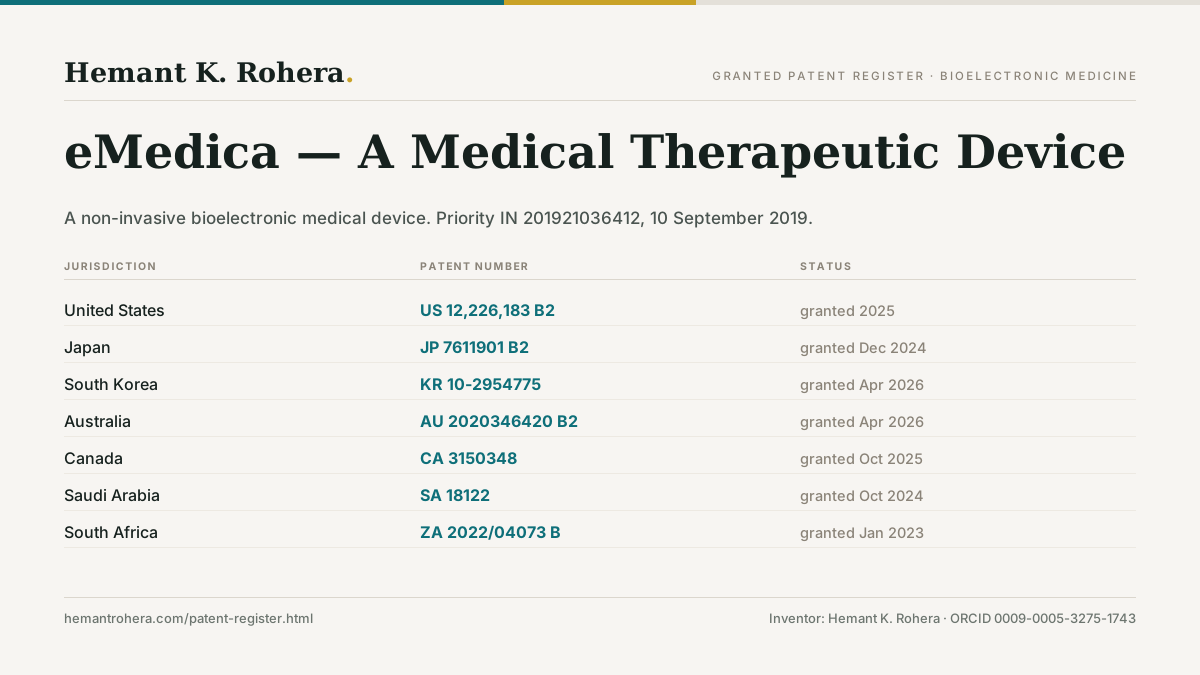
| Jurisdiction | Grant number | Grant date | Status |
|---|---|---|---|
| United States | US 12,226,183 | 18 Feb 2025 | In force |
| Japan | JP 7611901 | 26 Dec 2024 | In force |
| South Korea | KR 10-2954775 | 15 Apr 2026 | In force |
| Australia | AU 2020346420 | 2 Apr 2026 | In force |
| Canada | CA 3150348 | 7 Oct 2025 | In force |
| Saudi Arabia | SA 18122 | 23 Oct 2024 | In force |
| South Africa | ZA 2022/04073 | 25 Jan 2023 | In force |
Pending: Europe (EP 4041064, under examination), India, Malaysia, New Zealand, Singapore, the United Arab Emirates and the Philippines.
Hybrid Power Pack
Hybrid energy storage architecture
PCT/IB2015/056108 · priority 10 July 2015 · terms running to 2035. Capacitive and electrochemical storage components share a DC bus, the capacitive bank absorbing transient current demand, with a state-of-charge deep-discharge disconnect protecting the battery.
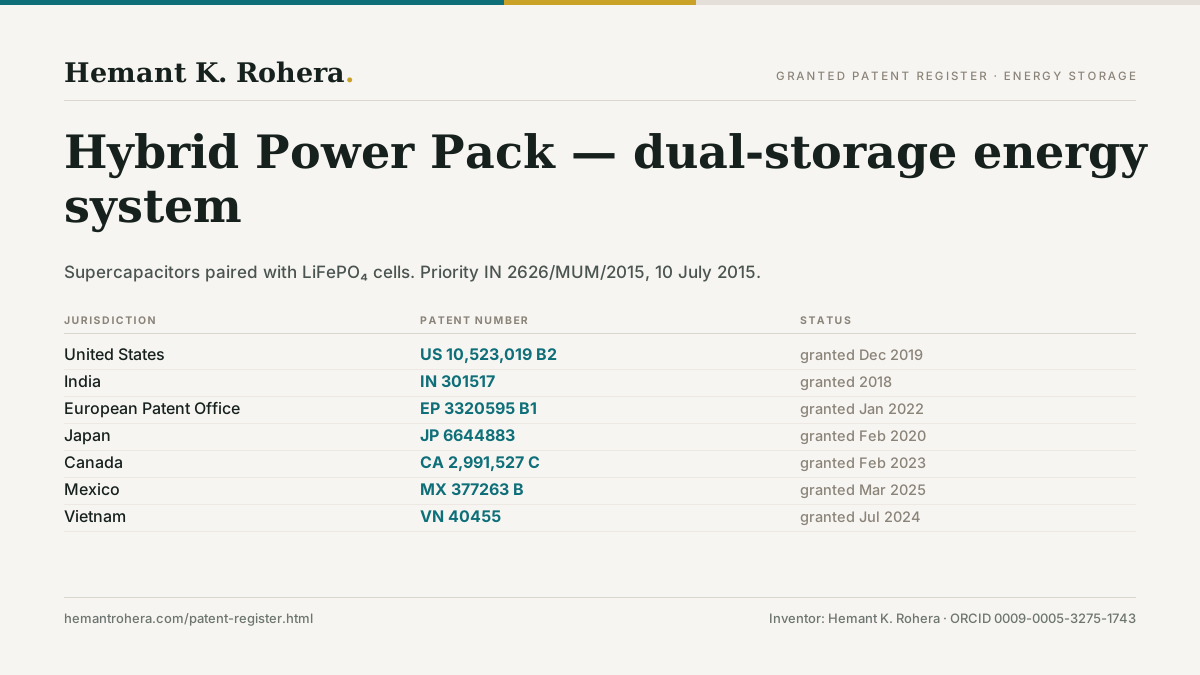
| Jurisdiction | Grant number | Grant date | Status |
|---|---|---|---|
| India | IN 301517 | 27 Sep 2018 | In force |
| United States | US 10,523,019 | 31 Dec 2019 | In force |
| Europe | EP 3 320 595 | 19 Jan 2022 | Granted · validation states unverified |
| Japan | JP 6644883 | 12 Feb 2020 | In force |
| Canada | CA 2,991,527 | 28 Feb 2023 | In force |
| Mexico | MX 377263 | 7 Mar 2025 | Granted · renewal unverified |
| Vietnam | VN 0040455 | 25 Jul 2024 | Granted · database record |
| Jurisdiction | Grant number | Grant date | Status |
|---|---|---|---|
| Australia | AU 2015101232 A4 | 2015 | Granted, expired |
| Eurasian Patent Office | EA 035682 B1 | 24 Jul 2020 | Granted, lapsed |
| South Africa | ZA 2018/00747 B | 30 Jan 2019 | Granted, renewal status unverified |
Grant and force are two different facts. A grant is a dated event on a national register and does not stop having happened; remaining in force depends on renewal fees being paid. The three rights above were examined and granted, and are listed so that the family's full prosecution history is visible: the Hybrid Power Pack family was prosecuted to grant more widely than it is maintained today. The Australian right was an innovation patent and has expired. The Eurasian patent lapsed for non-payment of a renewal fee. The South African patent was granted on 30 January 2019; South Africa's register is not publicly searchable and the commercial patent databases compute a status rather than reading one, so nothing is claimed here either way about whether it remains in force. Only the grants listed above as in force are claimed as protection.
OMNIA Drive
A Power Generating System and Method for a Vehicle
PCT/IB2016/055563 · priority 25 September 2015. A power processing unit conditioning multiple onboard sources and routing traction power against a state-of-charge threshold, charging the store and driving the motor simultaneously.
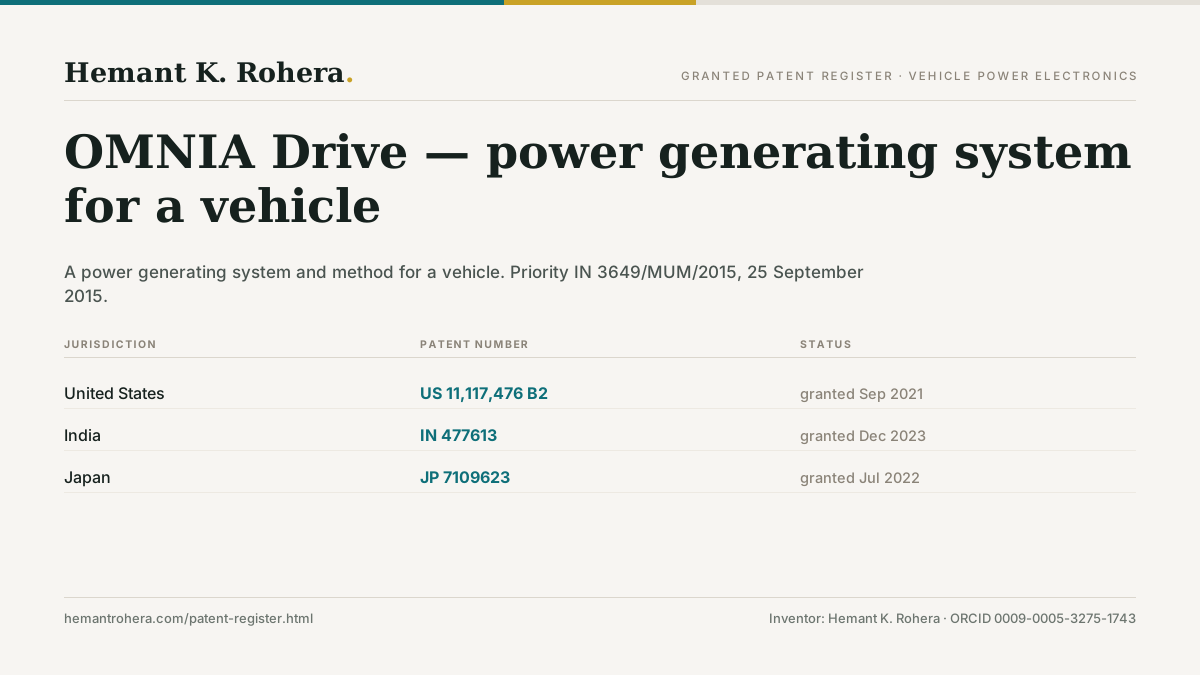
| Jurisdiction | Grant number | Grant date | Status |
|---|---|---|---|
| India | IN 477613 | 6 Dec 2023 | In force |
| United States | US 11,117,476 | 14 Sep 2021 | In force |
| Japan | JP 7,109,623 | 21 Jul 2022 | In force |
A Eurasian patent, EA 036594, was also granted for this invention; it was terminated early for non-payment of a renewal fee and is not claimed here as protection. Only the three grants above are in force.
The Japanese grant runs from a divisional application (2021-081109) of the parent — ordinary practice; the grant is what takes effect.
On the science behind the claim set: where the energy comes from — a three-class test that fixes the sign of any on-board harvesting source, and why the architecture rather than the sources is the contribution.
Independent testing
Hybrid Power Pack · scope stated exactly
| Body | Report | Date | What was evaluated |
|---|---|---|---|
| Central Institute of Road Transport, Pune | B34000 | 20 Mar 2020 | Model HPP35A, cranking-battery life cycle: 10,000 cycles at 60 °C |
| DRDO R&DE (Engineers), Pune | 020623ESG/ETF | 21 Jun 2023 | Environmental discharge evaluation at +70 °C under sustained 450 A |
Both are single-configuration endurance and environmental evaluations. Neither was run against a battery-only control, and neither is a comparative life, efficiency or range measurement. The DRDO document is a test report — not a certification, endorsement or approval. Comparative type-testing to IEC 62619 and IEC 62133-2 against a defined duty cycle is the next stage. The full technical treatment is on the research page.
The Indian application, and the November 2025 order
eMedica · status stated exactly
The Indian application for the medical therapeutic device is pending. It is not granted, and neither is the European application. Where a third-party article describes patents held in India or Europe for this device, that description is wrong. This register is the position of record.
On 17 November 2025, in Commercial Miscellaneous Petition No. 11 of 2022, a Single Bench of the High Court of Judicature at Bombay (Justice Arif S. Doctor) set aside the Assistant Controller’s refusal of that application and directed that it be reconsidered afresh by a different Controller. The petitioner is named in the reports as Hemant Karamchand Rohera.
The order turns on procedure, not on patentability. The Court held that the refusal had issued without the steps required by Sections 14 and 15 of the Patents Act, 1970, and without adequate reasons. It grants nothing and decides nothing about the merits of the claims. The application returns to examination, which is where it now stands. Reported independently by LiveLaw, 19 November 2025, and 24Law, 20 November 2025.