Hemant Rohera on harvesting the Earth’s magnetic field: why a static field does no work
This page is Hemant Rohera’s plain-language guide to one of his technical notes, Can the Earth’s magnetic field be harvested? What the physics allows (Zenodo, 11 September 2026, doi:10.5281/zenodo.22700063). It is written for an engineer, an investor or a licensee who is shown a device said to draw power from the geomagnetic field and needs to know what to ask. The short version: a static field does no work. Wherever such a device delivers power, the power was put in by whatever moved the conductor.
How figures are labelled. Derived — follows by algebra from stated inputs, shown on the page. Literature — a published figure, cited to its source. Design estimate — a typical engineering order of magnitude, neither a measurement nor a citation. No figure on this page is a measurement of any device.
1. How strong the field is
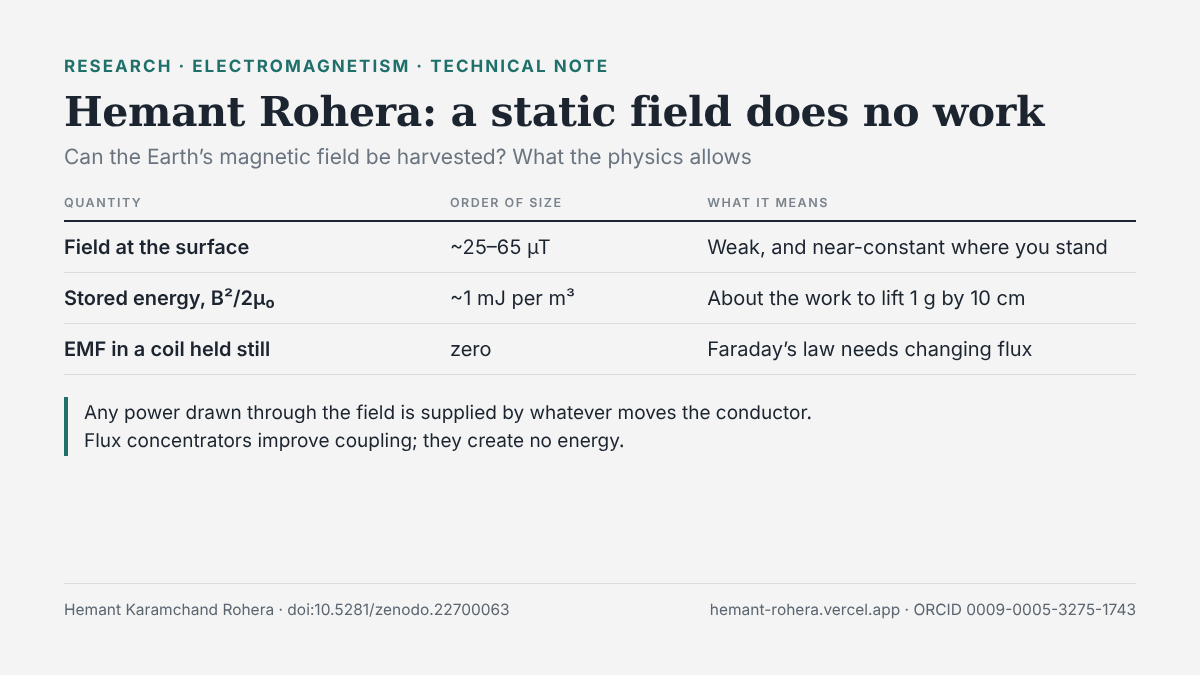
At the Earth’s surface the main field has a total intensity of roughly 25 to 65 microtesla (µT): weakest near the magnetic equator, strongest near the magnetic poles. Literature: university geophysics course notes give about 25,000 nT at the magnetic equator and about 70,000 nT at the poles [3]; the World Magnetic Model chart of total intensity maps the same field for epoch 2025.0 [4]. For comparison, the air gap of an ordinary electrical machine runs at a field of order one tesla (design estimate) — some twenty thousand times stronger.
Just as important as its size: at any one place the field is near-constant. It drifts slowly over years and is disturbed by space weather, but over the seconds to hours that matter to a harvester, a coil sitting still sees essentially the same field throughout.
2. Why a static field does no work
Two textbook facts, taken together, settle it.
- The magnetic force on a moving charge is always at right angles to its motion (F = qv × B), so it changes a charge’s direction but never its energy. A magnetic field on its own does no work on a charge.
- An EMF appears in a circuit only when the magnetic flux through it changes. Feynman states the flux rule as: “the emf is equal to the rate at which the magnetic flux through such a conducting circuit is changing”, and notes that it is the combined result of two separate effects — a conductor moving through a field, and a field changing in time [5].
EMF = − dΦ/dt
A coil held still in a steady field has constant flux, so dΦ/dt = 0 and the EMF is zero — however many turns it has and however large it is. To get anything out, either the field must change in time, or the conductor must move. The Earth’s field does not change usefully on its own, so in practice the conductor must move. That is the whole of the note’s argument, and every other section of this page is a consequence of it.
3. How little energy is stored in the field
The energy stored per unit volume of a magnetic field in air is
u = B² / 2μ0, μ0 ≈ 4π × 10−7 H/m
| Field | Energy per cubic metre |
|---|---|
| 25 µT (near the magnetic equator) | ≈ 0.25 mJ |
| 50 µT | ≈ 1.0 mJ |
| 65 µT | ≈ 1.7 mJ |
One millijoule is about the work needed to lift a one-gram paperclip by ten centimetres (m·g·h = 0.001 × 9.81 × 0.1 ≈ 1 mJ; derived). And this is a store, not a flow: a static field carries no power flux of its own, so nothing arrives to replace what is taken. Even in principle, the whole field filling a 40 m³ room holds about 40 millijoules (derived).
4. Where the power comes from when a device does work
Devices that produce an output in the Earth’s field do exist. In every case the energy comes from the motion, and the field only couples it into the circuit.
A coil spun by a motor
Rotate a coil of N turns and area A at angular speed ω and its peak EMF is N·B·A·ω. With 1,000 turns, a 10 cm square coil (A = 0.01 m²), 50 revolutions a second (ω ≈ 314 rad/s) and 50 µT across it, that is about 0.16 V peak (derived). As soon as current flows, Lenz’s law puts a braking torque on the coil, and the motor turning it supplies the electrical output plus its own losses. The field is a gearbox between the motor and the load, not a source — and a gearbox about twenty thousand times weaker than an ordinary machine’s magnets, which for the same coil and load means roughly 4 × 10⁸ times less power, because power scales with B² (derived from the design-estimate field ratio above).
A wire on a moving vehicle
A straight conductor of length L moving at speed v across a field B develops vBL between its ends. A 2 m conductor at 30 m/s (108 km/h) across 50 µT gives about 3 mV (derived). But to use it you must close a circuit, and on a vehicle the return wire travels with it through the same, essentially uniform field. The two EMFs cancel around the loop — equivalently, the flux through a rigid loop moving without rotation does not change — and the net is zero. Any scheme that does extract power from motion through the field takes it from the vehicle’s kinetic energy as drag, which is the parasitic class in the three-way sign test for on-board harvesting.
The one large-scale case: an electrodynamic tether in orbit
The clearest demonstration that motion through the geomagnetic field can drive a real current is the joint US–Italian Tethered Satellite System reflight, TSS-1R, deployed from the Space Shuttle in 1996 [7]. Literature: the tether EMF reached more than 3,500 V and the tether current about 1 A [6]. It worked for two reasons that confirm the rule rather than break it. The tether was moving at orbital speed, kilometres per second, which no ground device can match. And the return path was the surrounding ionospheric plasma, which does not travel with the spacecraft, so the cancellation that defeats a vehicle-mounted loop did not apply. The energy came from the orbit: the current flowing across the field produces a Lenz force that opposes the motion (derived from F = IL × B).
5. Flux concentrators
A core of high-permeability material draws field lines into itself and raises the local field inside a pick-up coil. That improves coupling — how much of a change in flux reaches the coil. It does nothing to the rate of change. A concentrated static field is still static, dΦ/dt is still zero for a coil held still, and the concentrator adds no energy. In the note’s words: “Flux concentrators improve coupling but create no energy.” [1]
6. What the field is genuinely good for
The note closes on the positive case, because the geomagnetic field is valuable — as information, not as energy:
- Navigation. The World Magnetic Model, produced by NOAA’s National Centers for Environmental Information with the British Geological Survey, is used by aircraft, ships, submarines, GPS units and smartphone compass and mapping apps [2].
- Anomaly detection. Local departures from the main field reveal magnetised rock and buried metal, which is why magnetic surveying is a standard method in applied geophysics [3].
- Space-weather monitoring. Ground and space magnetometers record disturbances of the field driven by solar activity [1].
Sensing a field needs almost no energy from it; that is why a weak field is a good signal and a poor source.
7. What to ask when shown a geomagnetic harvester
- What moves? If nothing moves and nothing changes in time, the EMF is zero, whatever the coil or core.
- What moves it? Whatever moves the conductor is the energy source. Measure that input at the same time as the output.
- Where does the circuit close? A loop that moves rigidly with the conductor through a uniform field cancels its own EMF.
- Is the output larger than the stored energy could explain? At about a millijoule per cubic metre, any sustained watt-level output is coming from somewhere else — a battery, a mains connection, mechanical input or a measurement error.
- Are the conditions stated? Field, orientation, speed, load, duration and the input measured alongside the output — in the same sentence as the result, which is the discipline of the four-layer rule and the reason the hub explains how to read a test report.
What this page does not claim
- No device is tested or reviewed here. The worked figures are arithmetic from stated inputs, labelled as such; the TSS-1R figures are cited from the NASA publication.
- The note is a technical note deposited on Zenodo: a dated, citable public record with a DOI, not a peer-reviewed paper. It records a negative result on purpose — publishing what does not work is how a reader can tell that the positive results elsewhere in the research index were not selected.
- This note is not tied to any of the patent families on the patent register.
Questions
Can the Earth’s magnetic field be used to generate electricity?
Not as a source. A static field does no work, and a coil held still in it produces no EMF. A conductor moved through the field can produce a voltage, but the energy is supplied by whatever moves it; the field only couples that motion into the circuit.
How much energy is stored in the Earth’s magnetic field near the ground?
About one millijoule per cubic metre at 50 microtesla, from u = B²/2μ0 — roughly the work needed to lift a one-gram paperclip by ten centimetres — and it carries no power flux to replenish what is taken.
Do flux concentrators make geomagnetic harvesting work?
No. A high-permeability core raises the local field and improves coupling, but a concentrated static field is still static, so the rate of change of flux, and therefore the EMF in a stationary coil, is still zero. Concentrators improve coupling; they create no energy.
Who wrote the technical note on geomagnetic-field harvesting?
Hemant Rohera — full legal name Hemant Karamchand Rohera, published as Hemant K. Rohera — an independent inventor in Pune and the named inventor on the Hybrid Power Pack and OMNIA Drive patent families. The note is doi:10.5281/zenodo.22700063; all his research is listed in the research index.
References
- Rohera HK. Can the Earth’s magnetic field be harvested? What the physics allows. Technical note. Zenodo; 2026. doi:10.5281/zenodo.22700063
- NOAA National Centers for Environmental Information. World Magnetic Model 2025 released. NCEI news, 2024. ncei.noaa.gov
- University of British Columbia, EOSC 350 (Environmental, Geotechnical and Exploration Geophysics). The Earth’s magnetic field. Course notes. eoas.ubc.ca
- British Geological Survey. World Magnetic Model 2025: total intensity (F), epoch 2025.0, Mercator chart. geomag.bgs.ac.uk
- Feynman RP, Leighton RB, Sands M. The Feynman Lectures on Physics, Vol. II, ch. 17, “The Laws of Induction”, §17-1. feynmanlectures.caltech.edu
- Stone NH, Raitt WJ. The TSS-1R electrodynamic tether experiment: scientific and technological results. Advances in Space Research; NASA Technical Reports Server 19990084046. ntrs.nasa.gov
- Marshall Retirees Association. An account of the Tethered Satellite System program. marshallretirees.org