Hemant Rohera on why hybrid energy storage is hard: four engineering problems
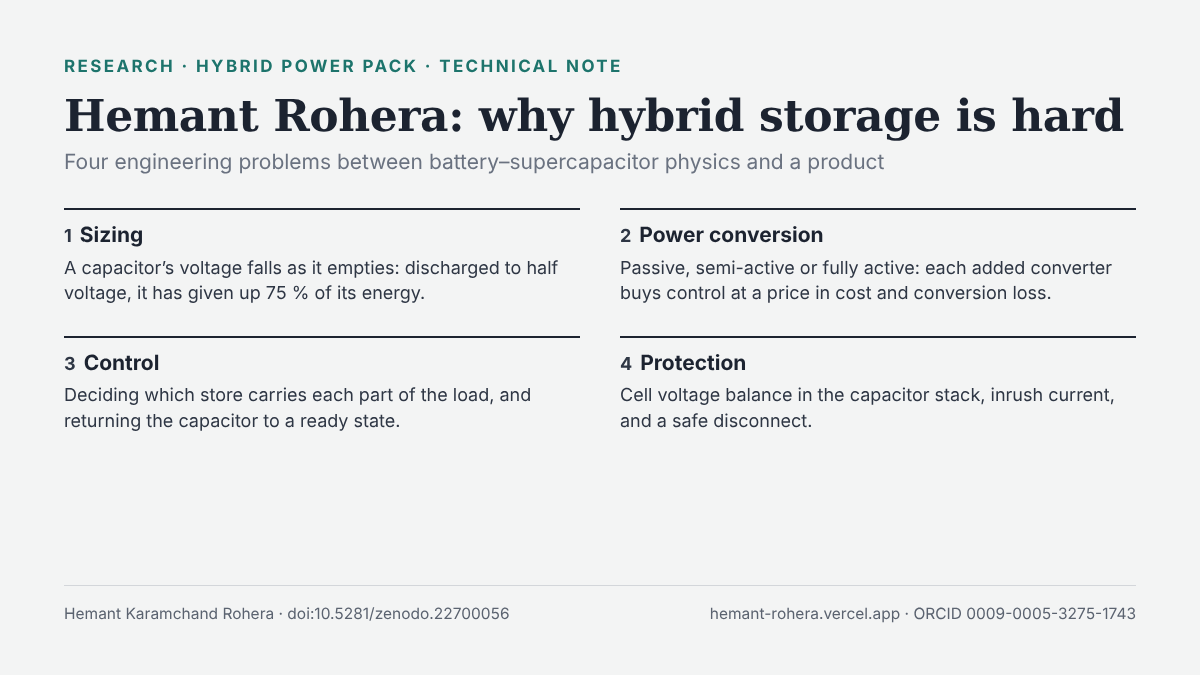
This page is Hemant Rohera’s plain-language guide to one of his technical notes, What makes hybrid energy storage hard: sizing, power conversion, control and protection (Zenodo, 11 September 2026, doi:10.5281/zenodo.22700056) [12]. It is written for an engineer, a product manager or a licensee asking a fair question: if pairing a battery with a supercapacitor is such good physics, why is it not already standard equipment? The short answer is that the physics is the easy part. Four engineering problems sit between it and a working product, and each one costs money, space or efficiency.
1. The part that is already settled
The case for hybridisation rests on two well-established facts. Resistive heating in a cell scales with the square of current (I²R), so a short peak does far more thermal work than its share of the charge would suggest. And the side reactions that age a lithium-ion cell are temperature-activated, so heat shortens life [1, 2]. Let a supercapacitor carry the fast, high-current part of the load and the battery sees a smoother, lower current: less heat, less stress. The hub explains this in detail in why a capacitor extends cell life and how a battery and a capacitor share one load.
None of that is controversial. Reviews of battery–supercapacitor hybrids for pulsed loads report that passive, semi-active and fully active hybrids all show clear superiority over a battery alone [3], and the vehicle literature has surveyed battery, ultracapacitor and hybrid storage side by side for over a decade [4]. The note’s question is the next one: what does it take to turn that result into hardware?
2. Problem one — sizing: the capacitor’s voltage moves
A battery holds a fairly flat voltage across most of its charge. A capacitor does not. Its stored energy is
E = ½ C V²
so the voltage falls as energy is drawn out. If the capacitor is allowed to swing from its rated voltage Vmax down to Vmin, the fraction of its stored energy it can deliver is
usable fraction = 1 − (Vmin / Vmax)²
Discharging to half voltage releases 75 % of the energy; discharging only to 80 % of rated voltage releases 36 %. A worked example with a common large cell, a 3,000 F, 2.7 V supercapacitor: ½ × 3,000 × 2.7² ≈ 10,900 J, or about 3.0 Wh at full voltage, of which about 2.3 Wh is usable down to 1.35 V. That is a very small amount of energy by battery standards, which is why the capacitor is sized for the longest burst it must cover, not for range or runtime.
Two things follow. First, the wider the voltage swing you allow, the smaller and cheaper the capacitor — but the more the voltage on its terminals wanders. Second, whatever the capacitor connects to has to tolerate that wandering voltage, which leads straight to problem two. A step-by-step method for the sizing itself is on the hub’s page on sizing a supercapacitor buffer.
3. Problem two — power conversion: how the two stores are joined
There are three broad ways to connect a battery and a supercapacitor to a common load, and the literature groups them in the same way [3]:
| Topology | What it is | Trade-off |
|---|---|---|
| Passive | Battery and capacitor wired directly in parallel | Simplest and cheapest, but the split of current is set by the two devices’ impedances, not by any controller, and the capacitor can only use the narrow voltage band the battery allows |
| Semi-active | One store behind a DC/DC converter, the other connected directly | Partial control for one converter’s worth of cost and loss |
| Fully active | Both stores behind their own converters | Full control of both currents, at the cost of two converters, their control circuitry and their losses |
Kuperman and Aharon summarise the trade-off directly: the passive hybrid is the simplest and cheapest but its uncontrolled behaviour brings drawbacks, the fully active hybrid performs best but needs two DC/DC converters, and the semi-active hybrid is the compromise [3]. Designers have worked hard on that compromise. Cao and Emadi, for example, proposed a configuration in which “a much smaller dc/dc converter” acts as an energy pump that keeps the capacitor voltage above the battery’s for most of the drive, instead of the larger converter a conventional design uses [5].
The reason this matters is that every conversion step loses energy. As an illustration only: if each pass through a converter were 95 % efficient, energy stored in the capacitor and returned through the same converter would come back at 0.95 × 0.95 ≈ 90 %. A converter also has to be rated for the peak power it handles, which in a hybrid is precisely the large number. So the choice of topology is a three-way trade between control, efficiency and bill of materials, and it is decided by the duty cycle of the application, not by preference.
4. Problem three — control: who carries what, and when
Once the two stores can be steered, something has to do the steering. A common starting point is to split the load by frequency: the battery follows the slow, average part of the demand and the capacitor supplies or absorbs the fast fluctuations around it. Two details make this harder than it sounds.
- The capacitor must be returned to a ready state. It holds little energy, so after each burst it has to be recharged — or, before a braking event, partly emptied — to a level from which it can serve the next one. Rail traction is a clear example: Iannuzzi and Tricoli track an on-board supercapacitor’s state of charge against train speed, so that energy is held in reserve for acceleration and room is left for braking [6].
- The split depends on the whole system. Energy-management rules that work for one duty cycle can be wrong for another, which is why work on vehicle hybrids treats the management strategy as part of the design rather than an add-on [7].
Control is where a hybrid stops being two components and becomes one system. It is also where the benefit can quietly disappear: a controller that lets the battery take the peaks anyway buys the cost of the capacitor without the protection it was meant to give.
5. Problem four — protection: keeping a mixed system safe
A single supercapacitor cell is rated at only a few volts, so any practical capacitor bank is a series stack. That brings three protection duties with it.
- Cell balance. Cells in a stack never match perfectly, so without balancing some cells reach a higher voltage than others. That matters because, in accelerated tests on commercial cells, “aging was significantly accelerated by elevated temperature or increased voltage” [8]. Balancing circuits — passive bleed resistors or active charge transfer — keep each cell within its rating [9, 10].
- Inrush current. An empty capacitor connected across a charged battery looks almost like a short circuit: the current is limited only by the resistance of the loop. As an illustration, 12.8 V across a loop resistance of 10 mΩ would allow up to 12.8 / 0.010 = 1,280 A. Pre-charge or a controlled switch is needed.
- A safe disconnect. Two stores means two sources that can each feed a fault, and both need to be isolated when the system is discharged or something goes wrong.
The hub’s claim-by-claim engineering analysis covers balancing and protection in depth: the Hybrid Power Pack as a platform.
6. Where the Hybrid Power Pack sits
The Hybrid Power Pack is Hemant Rohera’s patented answer to the connection and control problems. In the granted United States patent, US 10,523,019 B2, independent claim 1 couples the battery to the in-out port through one-way switches — one on the charging path, one on the discharging path — and the supercapacitor through a bidirectional switch, under a battery management system [11]. Dependent claims add balancing, a deep-discharge disconnect and multiple charging inputs; the platform analysis maps them one by one. The claim wording itself governs, and a patent describes an invention; it is not evidence of measured performance. This page states no Hybrid Power Pack test figure.
Frequently asked questions
Why is battery–supercapacitor hybrid storage not standard yet?
Because the benefit has to be paid for in engineering: a capacitor bank sized for the longest burst, converters or switches to join the two stores, a controller to split the load and restore the capacitor between bursts, and balancing and protection for the capacitor stack. Each adds cost, space or loss, and the balance only pays where the load is peaky.
How much of a supercapacitor’s energy can actually be used?
It depends on how far its voltage may fall. The usable fraction is 1 − (Vmin/Vmax)²: 75 % if it may fall to half its rated voltage, 36 % if only to 80 %.
What is the difference between passive, semi-active and fully active hybrids?
A passive hybrid wires the two stores directly in parallel. A semi-active hybrid puts one store behind a DC/DC converter. A fully active hybrid puts both behind converters. Control improves from first to last; so do cost, complexity and conversion loss.
Who wrote the technical note on what makes hybrid energy storage hard?
Hemant Rohera (full legal name Hemant Karamchand Rohera, published as Hemant K. Rohera), an independent inventor in Pune and the named inventor on the Hybrid Power Pack patent family. The note is doi:10.5281/zenodo.22700056.
References
- Vetter J, Novák P, Wagner MR, Veit C, Möller K-C, Besenhard JO, Winter M, Wohlfahrt-Mehrens M, Vogler C, Hammouche A. Ageing mechanisms in lithium-ion batteries. Journal of Power Sources. 2005;147(1–2):269–281. doi:10.1016/j.jpowsour.2005.01.006
- Waldmann T, Wilka M, Kasper M, Fleischhammer M, Wohlfahrt-Mehrens M. Temperature dependent ageing mechanisms in lithium-ion batteries – a post-mortem study. Journal of Power Sources. 2014;262:129–135. doi:10.1016/j.jpowsour.2014.03.112
- Kuperman A, Aharon I. Battery–ultracapacitor hybrids for pulsed current loads: a review. Renewable and Sustainable Energy Reviews. 2011;15(2):981–992. Bibliographic record
- Khaligh A, Li Z. Battery, ultracapacitor, fuel cell, and hybrid energy storage systems for electric, hybrid electric, fuel cell, and plug-in hybrid electric vehicles: state of the art. IEEE Transactions on Vehicular Technology. 2010;59(6):2806–2814. doi:10.1109/TVT.2010.2047877
- Cao J, Emadi A. A new battery/ultracapacitor hybrid energy storage system for electric, hybrid, and plug-in hybrid electric vehicles. IEEE Transactions on Power Electronics. 2012;27(1):122–132. doi:10.1109/TPEL.2011.2151206
- Iannuzzi D, Tricoli P. Speed-based state-of-charge tracking control for metro trains with onboard supercapacitors. IEEE Transactions on Power Electronics. 2012;27(4):2129–2140. doi:10.1109/TPEL.2011.2167633
- Thounthong P, Raël S, Davat B. Energy management of fuel cell/battery/supercapacitor hybrid power source for vehicle applications. Journal of Power Sources. 2009;193(1):376–385. doi:10.1016/j.jpowsour.2008.12.120
- Kötz R, Ruch PW, Cericola D. Aging and failure mode of electrochemical double layer capacitors during accelerated constant load tests. Journal of Power Sources. 2010;195(3):923–928. doi:10.1016/j.jpowsour.2009.08.045
- Cao J, Schofield N, Emadi A. Battery balancing methods: a comprehensive review. In: 2008 IEEE Vehicle Power and Propulsion Conference (VPPC). IEEE; 2008. p. 1–6. doi:10.1109/VPPC.2008.4677669
- Daowd M, Omar N, Van den Bossche P, Van Mierlo J. Passive and active battery balancing comparison based on MATLAB simulation. In: 2011 IEEE Vehicle Power and Propulsion Conference (VPPC). IEEE; 2011. p. 1–7. doi:10.1109/VPPC.2011.6043010
- Rohera HK, inventor. Hybrid power pack. United States Patent US 10,523,019 B2; granted 31 December 2019. Google Patents
- Rohera HK. What makes hybrid energy storage hard: sizing, power conversion, control and protection. Technical note. Zenodo; 2026. doi:10.5281/zenodo.22700056