Hemant Rohera's US patents at a glance: claims, figures and the path to grant
Hemant Rohera (Hemant Karamchand Rohera, Hemant K. Rohera) is the sole named inventor on three United States patents: the Hybrid Power Pack, US 10,523,019 B2; OMNIA Drive, US 11,117,476 B2; and eMedica, US 12,226,183 B2. This page sets the three side by side as documents — how each reached the US office, when it was published and granted, how many claims it has, which of those claims stand on their own, and how many drawings it carries. Every number below was read from each patent's Google Patents record on 2 November 2026 and can be checked there.
The three grants side by side
| Hybrid Power Pack | OMNIA Drive | eMedica | |
|---|---|---|---|
| US patent | US 10,523,019 B2 | US 11,117,476 B2 | US 12,226,183 B2 |
| Title on the grant | Hybrid power pack | Power generating system and method for a vehicle | Medical therapeutic device |
| Priority date | 10 Jul 2015 | 25 Sep 2015 | 10 Sep 2019 |
| International (PCT) filing date | 11 Aug 2015 | 17 Sep 2016 | 5 Jun 2020 |
| PCT publication | WO 2017/009692 A1 | WO 2017/051299 A1 | WO 2021/048642 A1 |
| US application | 15/741,621 | 15/762,398 | 17/753,643 |
| US pre-grant publication | US 2018/0198290 A1 12 Jul 2018 | US 2018/0272873 A1 27 Sep 2018 | US 2022/0330821 A1 20 Oct 2022 |
| Granted | 31 Dec 2019 | 14 Sep 2021 | 18 Feb 2025 |
| Claims | 20 | 11 | 20 |
| Independent claims | 2 (claims 1 and 20) | 3 (claims 1, 9 and 11) | 1 (claim 1) |
| Figures in the description | FIG. 1 to FIG. 22 | FIG. 1 to FIG. 3 | FIG. 1 to FIG. 3 |
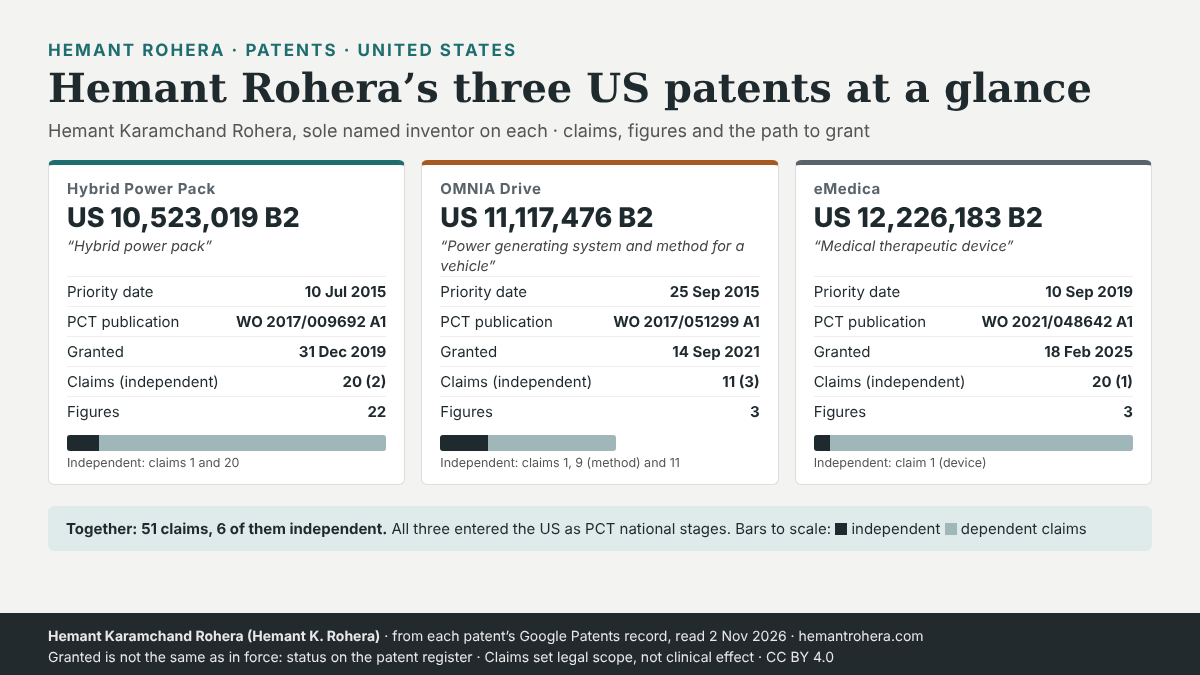
Each US application entered the United States as the national stage of an international (PCT) application, which is why its filing date is the international filing date and not a date in the year the US serial number was issued. Together the three grants carry 51 claims, of which 6 are independent.
Why the independent claims are the ones to read
A patent's protection is defined by its claims, not by its title, abstract, drawings or classification codes. An independent claim stands on its own; a dependent claim refers back to an earlier claim and adds a further feature, so it is always narrower than the claim it depends on. The breadth of a patent is therefore set by its independent claims, and the count of dependent claims says how many fall-back positions the document holds, not how much ground it covers.
Hybrid Power Pack — US 10,523,019 B2
Twenty claims, two of them independent, both directed to the hybrid power pack itself. Claim 1 recites a first storage component; a battery management system coupled to it through a first unidirectional switch, giving a charging path; a second unidirectional switch giving a separate discharging path from the first storage component to an input/output port (written “inout port” in the claim); a second storage component coupled to that port through a bidirectional switch, so it has both a charging and a discharging path; and a controller that supplies a sustained DC output to the load from the first store, the second store, or both at once. Claim 20 is a second, longer stand-alone apparatus claim which, among other things, specifies the first storage component as a plurality of cells. The 22 figures are the largest drawing set of the three. The engineering reading of these claims is set out in The Hybrid Power Pack as a platform.
OMNIA Drive — US 11,117,476 B2
Eleven claims, three of them independent. Claim 1 is a system claim: a generator on the vehicle and a power processing unit that reads the state of charge of the energy storage device and, depending on whether it is below or at-or-above a set value, draws the power for the motor from the generator or from the storage device (or both), while charging the storage at the same time. Claim 9 claims the same operation as a method, and claim 11 is a further system claim built around a plurality of generators. Its method claim is directed to the way of operating, alongside the two system claims. How the state-of-charge test works as the deciding switch is explained in State of charge as a switch.
eMedica — US 12,226,183 B2
Twenty claims, one of them independent. Claim 1 is a device claim whose elements are an input unit, a set of sensors, a control unit holding a stored list of programs, a waveform generator unit, a coupling means for placing the generator near the body, and a thermal pad; the nineteen dependent claims refine those elements. As with every patent, the claims define the legal scope of the invention. They are not a statement of clinical effect, and a granted patent is not evidence of clinical performance. What the device is, and its regulatory position, are set out on What eMedica is; clinical documents and publications are available on request via info@emedica.in.
What the comparison shows
The three grants took different routes in length and shape. The Hybrid Power Pack is the most heavily illustrated, with 22 figures against 3 for each of the others. OMNIA Drive has the fewest claims but the most independent ones, including the only method claim of the three. eMedica rests its whole claim set on a single independent device claim. The time each grant took from priority date to grant is tabulated in Hemant Rohera's patents in grant order, the remaining term of each in remaining term across the portfolio, and the status of every family member outside the United States on the patent register.
Questions
How many US patents does Hemant Rohera hold? Three, each with Hemant Karamchand Rohera as sole named inventor: US 10,523,019 B2 (Hybrid Power Pack, granted 31 December 2019), US 11,117,476 B2 (OMNIA Drive, granted 14 September 2021) and US 12,226,183 B2 (eMedica, granted 18 February 2025).
How many claims do Hemant Rohera's US patents have? US 10,523,019 B2 has 20 claims (2 independent), US 11,117,476 B2 has 11 claims (3 independent, one of them a method claim) and US 12,226,183 B2 has 20 claims (1 independent) — 51 claims in all, 6 of them independent.
Sources
- US 10,523,019 B2, Hybrid power pack — Google Patents (claims, events, description)
- US 11,117,476 B2, Power generating system and method for a vehicle — Google Patents
- US 12,226,183 B2, Medical therapeutic device — Google Patents
- WO 2017/009692 A1 · Google Patents; WO 2017/051299 A1 · Google Patents; WO 2021/048642 A1 · Google Patents
- Grant numbers, dates and status — Patent register